Attitude determination for small satellites with infrared Earth horizon sensors"
August 1, 2018· ,,·
0 min read
,,·
0 min read
Tam Nguyen
Kerri Cahoy
Anne Marinan
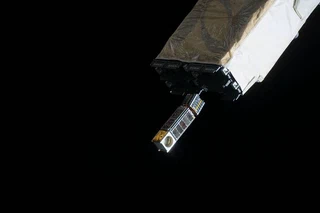 MicroMAS deployed from the ISS
Abstract
Infrared Earth horizon sensors are capable of providing attitude knowledge for satellites in low Earth orbit by using thermopile measurements of the Earth’s infrared emission to locate the Earth’s horizon. Because some small satellites, such as CubeSats, have limited resources, a framework was developed that improves the attitude determination performance of an Earth horizon sensing system consisting of inexpensive thermopiles in static dual-mount configurations by leveraging mission geometry properties and improving sensor models. This paper presents an analytical approach to generate an estimate of the nadir vector in the satellite’s body frame from Earth horizon sensor measurements. On-orbit telemetry data from the Microsized Microwave Atmospheric Satellite (MicroMAS) during limb-crossing events were used to assess our model of sensor readings in response to Earth horizon detection. To quantify the expected attitude estimation performance of our method, a detailed simulation of a low-Earth-orbiting satellite was developed with Earth horizon sensors in similar configurations to the MicroMAS sensor system. Our attitude determination method returns an error of 0.16° on average (root-mean-square error of 0.18°) in nadir estimation under a periodic low-frequency attitude disturbance of 4°. A sensitivity analysis was conducted, which takes mounting uncertainty and position error into account, resulting in an additional attitude error of 0.3° for a mounting offset of 0.2° and up to 0.13° error for a 10-km position knowledge error.
Type
Publication
Journal of Spacecraft and Rockets
