Fine-pointing performance and corresponding photometric precision of the Transiting Exoplanet Survey Satellite
September 4, 2018· ,,,,,,,,·
0 min read
,,,,,,,,·
0 min read
Tam Nguyen
Edward Morgan
Roland Vanderspek
Alan Levine
Miranda Kephart
James Francis
Joseph Zapetis
Kerri Cahoy
George Ricker
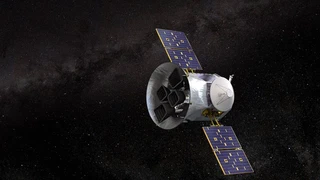 The Transiting Exoplanet Survey Satellite (TESS) Mission. Credit: NASA
Abstract
The Transiting Exoplanet Survey Satellite (TESS) is an MIT-led, NASA-funded Explorer-class planet finder launched in April 2018. TESS will carry out a 2-year all-sky survey with the primary goal of detecting small transiting exoplanets around bright and nearby stars. The TESS instrument consists of four wide-field cameras in a stacked configuration, providing a combined field of view of 24 deg × 96 deg that spans approximately from the ecliptic plane to the ecliptic pole. In order to achieve the desired photometric precision necessary for the mission, TESS uses the instrument cameras as star trackers during fine-pointing mode to enhance attitude accuracy and stabilization for science operations. We present our approach in quantifying the expected performance of the fine-pointing system and assessing the impact of pointing performance on the overall photometric precision of the mission. First, we describe the operational details of the fine-pointing system with the science instrument being used for star-tracking. Next, we present the testing framework used to quantify the attitude determination performance of the system and the expected attitude knowledge accuracy results, both in coarse-fine pointing hand-off and in nominal fine-pointing conditions. By combining simulations of the instrument and the spacecraft bus, we quantify the closed-loop fine-pointing stability performance of the system in nominal science operations as well as in the case of camera unavailability due to Earth/Moon interference. Finally, we assess the impact of platform pointing stability on the photometric precision of the system using detailed system modeling and discuss the applicability of mitigation techniques to reduce the effect of jitter on TESS science data.
Type
Publication
Journal of Astronomical Telescopes, Instruments, and Systems
